The Artist
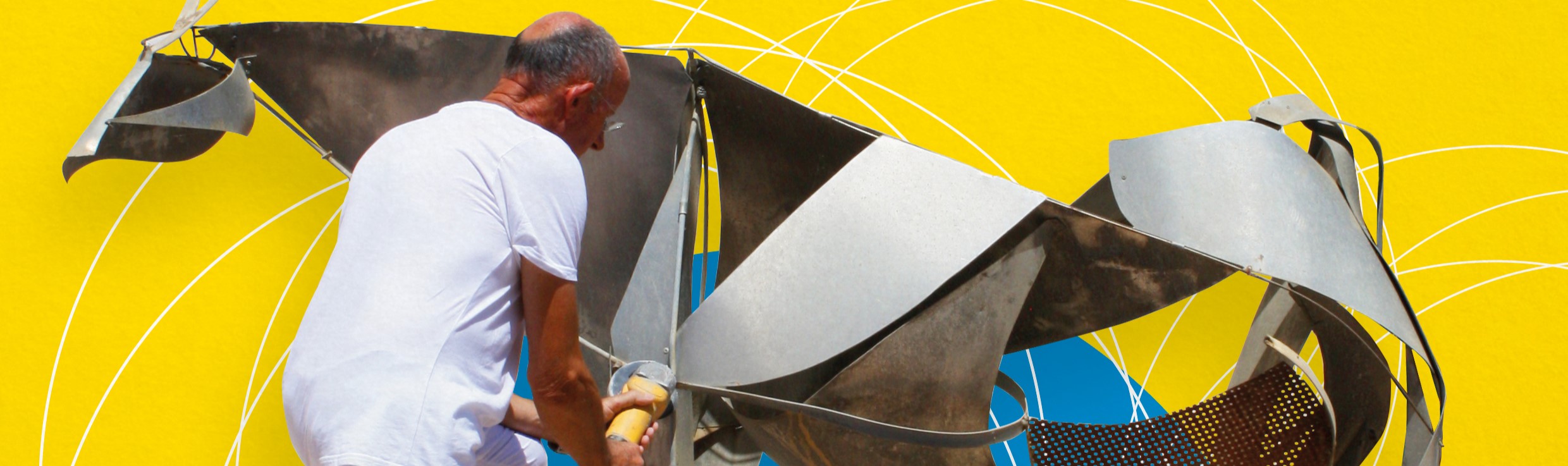
Biography
Antonis Pavlakis was born in 1949 in Stalos, Chania, Crete. From 1970 to 1975, he studied at the Athens School of Fine Arts, specializing in:
- Painting
- Sculpture
- Stage Design
- Art Theory and History
From 1976 to 2010, he taught art in secondary schools in Chania.
Throughout this time, and continuing to the present day, he has worked in his studio in Stalos, creating sculptures and paintings.
He has installed large-scale works and monuments in public spaces across Crete, as well as works in private spaces, hotels, and residences.
He regularly participates in art exhibitions in Crete and Athens. In parallel, he has designed stage models for theatre, architectural applications, and visual interventions.
General Interpretations of His
Sculpture and Painting
His works maintain connections with the spaces in which they are placed, yet these spaces function simultaneously as real, imaginary and transcendent. The works enter into dialogue with one another, exert mutual influence and exchange energy, both actual and hypothetical, creating unity and continuity. Their relationships are observed in their connection to space, in movement, in the tendency toward simplicity and abstraction, and in the sense of presence within an imaginary environment where visible and invisible forces coexist. Across all his sculptures and paintings, despite the dynamic abstraction, their identity remains recognizable.
His Philosophy of Visual Art
Visual art serves and nourishes the spirit and emotions of people today. Art should provide the emotional balance we need within an excessively controlled and demanding daily life.
Art expresses absolute freedom and democracy in thought and expression.
In a painting or sculpture, all elements coexist in balance and harmony, bound together while radiating positive energy. Only in this way do they acquire timeless artistic value. Art is not about seeking to impress, egoism or a decorative surface. It is a continuous process of research and exploration, recording lived experience and emotion with existential sensitivity.
Art is neither an end in itself nor a random transcendence.
It is a conscious search into the creator’s possibilities. An artwork is neither indifferent nor inexplicable.